

How has technology changed - and changed us - in the past 20 years?
**Source: Madeleine Hillyer Lead, Center Programming and Public Engagement, World Economic Forum** Just over 20 year...
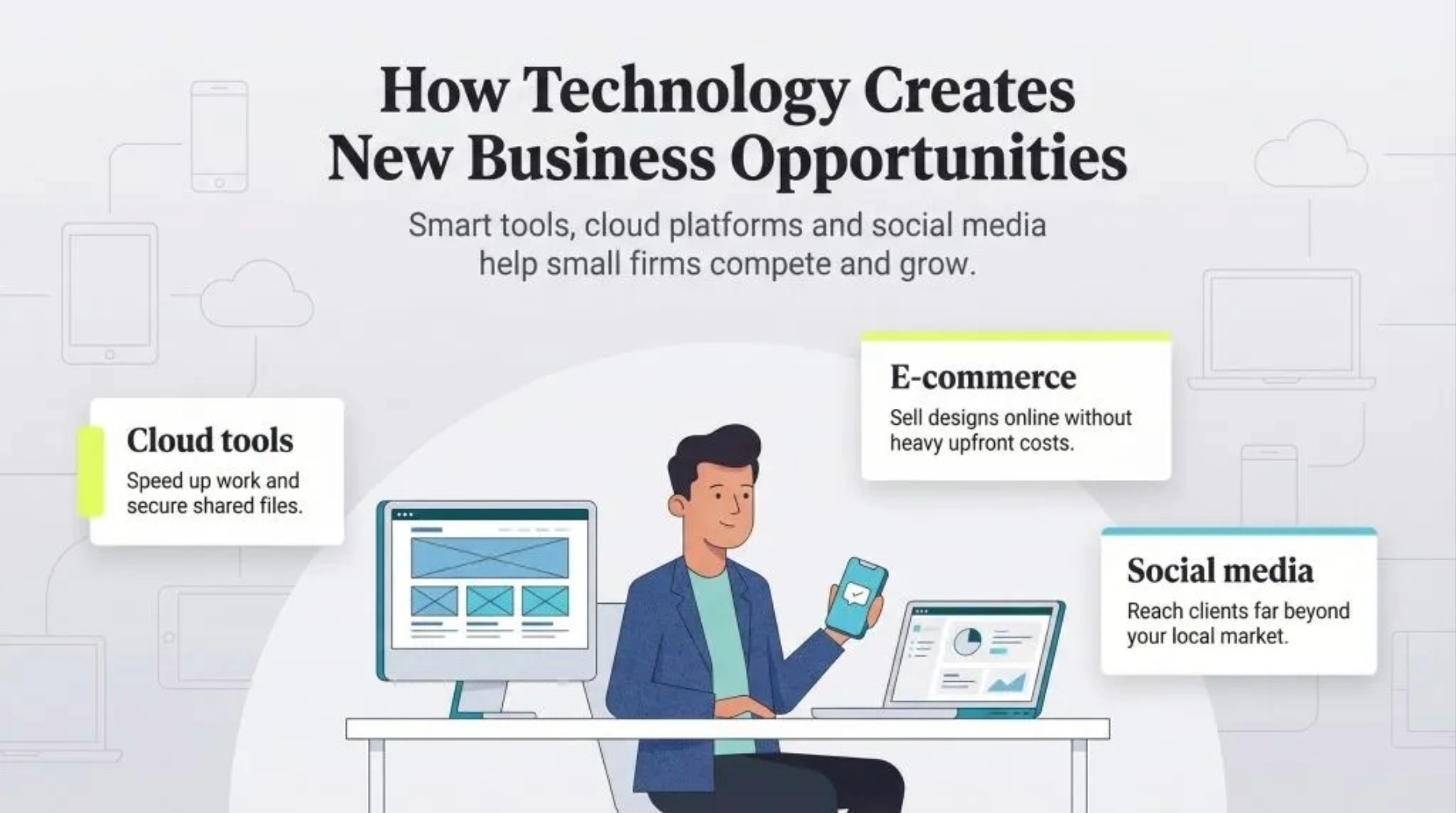
Heading a small design firm comes with its share of challenges. However, Dean Gallagher, co-founder of Fresh Folio Design, a design firm in suburban Chicago, has found that technology eases burdens, streamlines operations and opens new opportunities for businesses.
Technology influences nearly every aspect of Gallagher’s company, including how designs are created and delivered. He’s not alone — staying aware of technology trends can help businesses operate more smoothly, market more effectively and identify new ways to pivot products and services. We sat down with Gallagher to discuss how technology can open doors and create business opportunities. We’ll also share some important tech trends to watch that can help guide your business’s future.
Today, every company is a technology company, as our digital-first world governs customer service, business communications, marketing, operations and more. We asked Gallagher about the role technology plays in his business, including how it’s utilized and the opportunities and benefits it has created.
What devices do you use daily? Gallagher shared that he uses several devices daily for business operations, each with a different purpose. “The primary go-to devices would have to be our Mac Pro, iMac and iPhones,” Gallagher told us. “As far as actual design work we do, the computers are indispensable, but as far as timely communication, working without smartphones seems unthinkable.”
What technology do you use to get ahead of your competition? Standing out from the competition is critical in a competitive business landscape, and technology makes it easier to update your processes and stay current. Gallagher said that in the past, his firm had to replace its computers every few years to keep up with increasingly demanding design software. Today, faster processing speeds and cloud computing tools make it possible for design teams to do that work without relying on constant hardware upgrades.
In his particular business, aside from working with the best design software and having devices that can take advantage of it, technology isn’t necessarily a differentiator. “From a technology standpoint, there really isn’t much that a small graphic design company can do to get ahead,” Gallagher explained. All design firms likely use similar technology and understand the importance of staying current. However, technology can improve other aspects of running a business, and that’s where Gallagher’s company stands out. For example, technology can improve customer communication and help a business deliver a customer-delight standard of service.
Gallagher’s business also takes advantage of technology to facilitate sharing work with clients — a crucial way to stand out from the competition. In the early days, file sharing required proximity to the client or delivery via UPS or the United States Postal Service. That has changed thanks to modern collaboration platforms like Google Drive, Microsoft OneDrive and advanced file transfer solutions. “Fortunately, as connectivity speeds have increased, almost all of our file delivery has become digital,” Gallagher noted. Digital file management practices also help ensure the security and accessibility of crucial documents and data.
Is technology a significant enabler for your business? “Oh, absolutely,” Gallagher said, noting that when his wife first started in the industry, computers were just beginning to be used as part of graphic design. “I can’t even fathom what it must have been like to concept and lay out any sizable pieces,” he mused.
But it isn’t just about the speed and ease with which graphic design work can be done today. Technology has changed the industry itself by shaping new workflows, graphic design trends and best practices. For example, website design is a graphic design subset with significant tech underpinnings. Additionally, digital, variable and high-quality printers have helped level the playing field for smaller graphic design firms, allowing them to compete with bigger outfits.
However, the ability to set up an online store is one of the biggest tech enablers for smaller graphic design businesses. Customers can now discover and purchase even a small firm’s products with ease. Gallagher shared that his team launched an Etsy store to sell its hand-lettered artwork and is now building its own e-commerce platform. He noted that even a few years ago, creating, printing and selling those pieces would have been far more complicated.
Has social media influenced your business at all, from internal employee policies to the way you promote your company? Social media has significantly changed Fresh Folio’s promotion and reach. “When we started, most of our business came through word of mouth, and networking was more face-to-face,” Gallagher explained. The internet has changed that, and the company is no longer limited to local clients. “You can easily work with a company on the other side of the country or the other side of the world,” he added.
Gallagher acknowledged that keeping up with an active social media presence and social media marketing is challenging for a smaller design house. Still, fresh content, including a small business blog, is essential to the firm’s social media strategy. “One of the priorities that we’ve had was producing a weekly blog for each site and working on improving our social media outreach for both sites,” Gallagher shared. Have you had to adapt your business because of security concerns from the increased use of technology? Cybersecurity and risk management, fortunately, have not been major issues for Gallagher’s firm. “Because of our [small] size, up to this point, there hasn’t been much of a need for concern,” Gallagher said. Still, he stresses that the company takes steps to safeguard vital business and client data. “We continue to keep updated on potential threats and have antivirus and malware protection to prevent being blindsided,” he said.
New technology trends
 Business owners should track industry trends to stay alert to new technology and advances that benefit their companies. Consider the following business trends with digital elements that could lead to new opportunities for your organization:
Consumer insights through AI analytics: Advanced AI tools now enable businesses to gather deeper consumer insights through sophisticated sentiment analysis and predictive modeling. Research from the IBM Institute for Business Value found that organizations with more mature AI-driven customer capabilities report customer satisfaction rates about 17 percent higher than their peers. These tools analyze social media conversations, reviews and customer interactions to identify emerging trends and unmet needs. Intelligent process automation: Beyond basic automation, intelligent process automation (IPA) combines AI with robotic process automation (RPA) to handle complex tasks. Federal agencies using RPA and intelligent automation tools have created many automated workflows that free up hundreds of thousands of hours of manual work by speeding up repetitive processes and improving accuracy. For example, one analysis of federal automation programs reported that agencies have built nearly 1,000 automations that substantially increase processing capacity and reduce manual workload. Small businesses can leverage IPA for inventory management, customer onboarding and financial reporting. Data-driven decision-making: Technology and data are improving and speeding up business decision-making. For example, toll operators use dynamic pricing models that adjust fees based on the time of day and the amount of traffic currently flowing. This approach helps better manage traffic while helping operators boost revenue. Platform economy expansion: Businesses are increasingly building on shared digital platforms to grow without heavy upfront investment. U.S. Bureau of Economic Analysis data show that the digital economy accounted for about 10.3 percent of U.S. gross domestic product in its most recent measurement, underscoring how central digital platforms have become to economic activity. More recent industry research puts that share closer to 18 percent of U.S. GDP as of 2025. That growth makes it easier for companies to rely on shared services like cloud computing, logistics and fulfillment networks instead of investing heavily in their own infrastructure. 5G and edge computing: The continued rollout of 5G networks is reshaping how businesses of all sizes operate. According to FCC data, 96 percent of U.S. homes and small businesses had access to 5G mobile service at benchmark speeds in 2025, making real-time tools and Internet of Things devices easier to use. When paired with edge computing (which processes data closer to where it’s generated rather than in a centralized cloud), 5G reduces latency and improves performance for specific use cases, such as augmented reality customer experiences and real-time inventory tracking. Zero-trust security architecture: As cyberattack threats get more complex, many businesses are rethinking how they control access to their systems. A zero-trust approach stems from a simple concept: Users and devices aren’t automatically trusted, even once they’re inside a network. Access is checked continuously instead of granted once and forgotten. Guidance from groups like the Cybersecurity and Infrastructure Security Agency is encouraging this shift away from older, perimeter-based security models. There’s also a clear cost benefit to this approach. IBM cybersecurity research reports that organizations using mature zero-trust strategies have about $1.76 million lower average data breach costs than those without these protections. In other words, by limiting how far attackers can move once they get in, zero trust helps keep data breaches smaller and easier to contain. Generative AI integration: It’s no surprise that generative AI is a growing technological force. Census data shows that about 17 percent of U.S. businesses are using AI in some capacity, with industries like information, finance and insurance, and professional services leading the way. (The Census updated its survey questions in late 2025 after finding that earlier versions missed many everyday uses of AI across business operations.) Businesses of all sizes are turning to generative AI for tasks like writing marketing copy, developing code, handling customer questions and exploring early product or design ideas.
**Source: Madeleine Hillyer Lead, Center Programming and Public Engagement, World Economic Forum** Just over 20 year...
Let’s build something extraordinary together.
Contact Us