

How Professional Service Agencies Can Organize Client Information More Effectively
###How Professional Service Agencies Can Organize Client Information More Effectively ##The hidden cost of scattered ...
Growth is exciting for any business. More customers, more opportunities, and increased demand are often signs that an organization is moving in the right direction.
However, growth can also expose operational weaknesses.
Tasks that were manageable when serving a small customer base can quickly become overwhelming as workloads increase. Manual processes, spreadsheets, repetitive administrative work, and disconnected systems often create bottlenecks that limit a business's ability to scale effectively.
This is where business automation becomes a powerful advantage.
Business automation is the process of using technology to perform repetitive tasks, streamline workflows, and reduce the need for manual intervention.
Instead of relying on employees to complete routine administrative activities, automation helps systems handle these processes consistently and efficiently.
Examples of business automation include:
Automation allows businesses to focus more time and energy on delivering value rather than managing repetitive work.
In the early stages of a business, manual processes often seem manageable.
A business owner may personally schedule appointments, track customer information, generate reports, and follow up with clients.
As the organization grows, these same activities can consume significant amounts of time.
Common challenges include:
Without automation, growth frequently requires additional staff simply to maintain existing operations.
This can increase costs while reducing overall efficiency.
One of the greatest benefits of automation is the ability to eliminate repetitive tasks.
Activities that previously required manual effort can often be completed automatically through predefined workflows.
For example:
Instead of manually sending appointment reminders, a system can automatically notify customers before their scheduled visit.
Instead of preparing recurring reports by hand, dashboards can generate insights automatically.
Instead of manually assigning new leads, a workflow can distribute opportunities to the appropriate team member.
These improvements save valuable time while reducing the likelihood of errors.
Humans make mistakes.
Data entry errors, forgotten follow-ups, missed communications, and inconsistent procedures are common challenges in every organization.
Automation helps create consistency by ensuring that processes are performed according to predefined rules.
Benefits include:
When repetitive tasks are automated, teams can spend less time correcting mistakes and more time focusing on strategic initiatives.
Customers expect timely responses and efficient service.
Businesses that rely entirely on manual processes may struggle to meet these expectations as demand increases.
Automation can help improve customer experiences by providing:
When routine interactions are handled efficiently, customers benefit from a smoother and more professional experience.
Employees bring the most value when they are solving problems, serving customers, and contributing to business growth.
Unfortunately, many teams spend a significant portion of their day performing administrative tasks that could be automated.
Business automation allows employees to focus on:
Rather than replacing people, automation helps people work more effectively.
As businesses expand into multiple locations, operational complexity increases.
Managing teams, customers, schedules, and reporting across locations often requires significant coordination.
Automation can help standardize workflows and ensure consistency across the organization.
Examples include:
This allows businesses to maintain quality and visibility even as operations become more distributed.
Automation becomes even more effective when it is integrated into a unified business platform.
When customer information, scheduling, reporting, and operational workflows exist within the same environment, automation can work across the entire organization rather than within isolated applications.
This creates opportunities to:
Businesses often achieve the greatest results when automation is built into the systems they use every day.
Business automation does not require replacing every process overnight.
Organizations should begin by identifying repetitive activities that consume time and provide limited value.
Questions to ask include:
Starting with a few high-impact improvements can generate meaningful results and create momentum for broader operational enhancements.
Successful businesses are not built by working harder alone. They are built by working smarter.
As organizations grow, manual processes become increasingly difficult to manage and scale. Business automation provides a practical way to improve efficiency, reduce administrative burdens, and create a foundation for sustainable growth.
By automating repetitive tasks and streamlining workflows, businesses can spend less time managing operations and more time focusing on customers, innovation, and long-term success.
The goal of automation is not simply to save time. It is to create a business that can grow efficiently, operate consistently, and adapt confidently as opportunities arise.
###How Professional Service Agencies Can Organize Client Information More Effectively ##The hidden cost of scattered ...
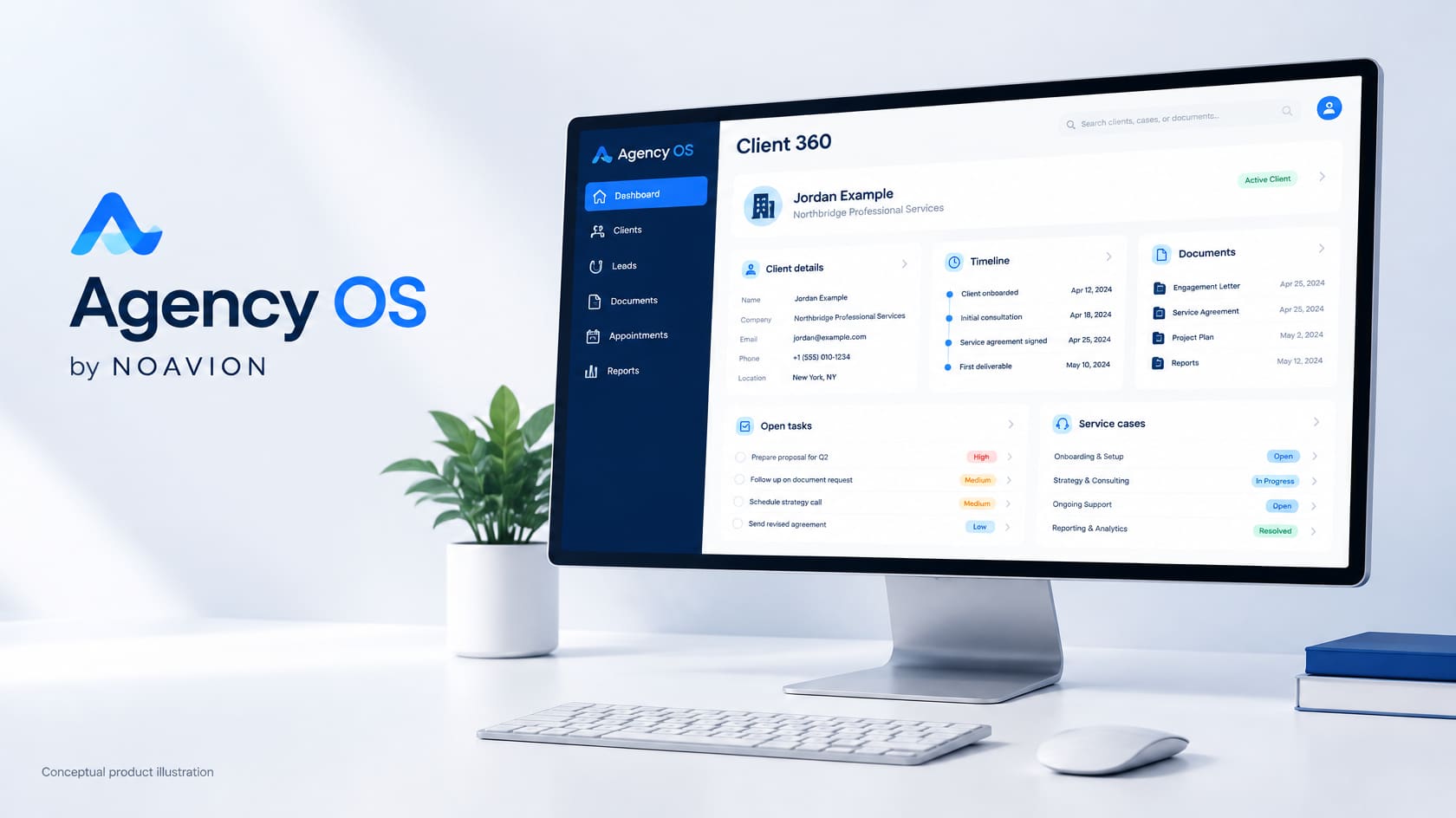
###Why a Dedicated Client Portal Matters for Service Businesses ##Clients need clarity, not another inbox When a cli...

Running a modern business has never been easier, yet many business owners feel more overwhelmed than ever. Over the l...
Let’s build something extraordinary together.
Contact Us